Thursday, October 1, 2015

Banned Book Week at UNT Dallas Library

Be The First To Comment
 UNT Dallas Library is observing Banned Books Week. Check out the online display here!

Banned Book Week is the national book community's annual celebration of the freedom to read. Hundreds of libraries and bookstores around the country draw attention to the problem of censorship by mounting displays of challenged books and hosting a variety of events.

Tuesday, September 29, 2015

Pack a Snack

Be The First To Comment
Snacking is a huge topic in the news and among clients (Is eating more snacks better? Should I eat between meals? Is 5 small meals better than 3 large meals?) I recommend that clients eat when they're hungry, which often includes eating several snacks throughout the day, especially if you're very active or you're an athlete. 

Packing snacks to bring to work or school is a great way to ensure you don't get stuck buying something over-priced from the school or work cafeteria or the vending machine (where the healthy pickings are slim). 

Knowing which foods to pack as a healthy snack can save you money, provide you with more nutrients and fuel your body throughout the day. This is especially true for active people and athletes, who need more calories than the "average" person. Our bodies utilize nutrients better when we spread them throughout the day and timing meals and snacks to fuel activities and help our bodies recover can improve performance. 

Comparing the Numbers

The USDA reports:
  • fruit roll snacks are about 82 calories and 28 cents per portion
  • bananas are about 100 calories and on average, about 18 cents per portion
Although fruit rolls/snacks and other foods of this variety can seem like a good deal because they often go on sale and may have health claims such as "100% fruit" or "An excellent source of vitamin C!", bananas and other fruits are often just as budget-friendly and contain more nutrients (that aren't necessarily advertised) to fuel your body than snack foods. 

Pre-packaged foods aren't ALWAYS a bad choice, but if you can build a more complete, nutrient-dense snack with foods from several food groups, you'll stay fuller for longer and your body will be getting more vitamins, minerals and fiber. 

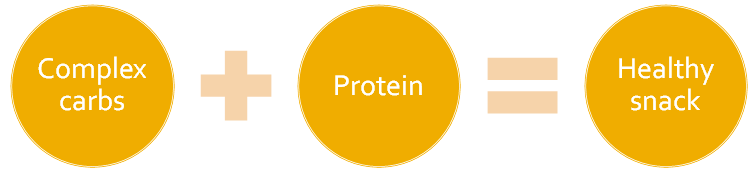
The easiest way to choose a filling nutritious snack is to follow this formula:


1. Complex carbohydrates
 
Complex carbs are fruits, vegetables and whole grains. 

Common examples include: apples, bananas, carrots, whole grain crackers, whole grain bread, potatoes, brown rice, raisins, granola, whole grain cold cereal or oatmeal and legumes/beans (chickpeas, black beans, peas, etc.)


2. Protein

Protein sources are dairy foods, meat and poultry, and nuts and seeds.

Common examples include: yogurt (Greek yogurt has more protein!), milk, cheese, lunch meat, chicken, hard boiled eggs, almonds or other nuts.

How much protein do you need? You're probably getting enough, but make sure you're getting some as part of your snacks!

The Academy of Nutrition and Dietetics recommends making small swaps to your normal grocery cart by looking at the foods you "always" eat each week and trying to make a swap for a more nutritious option. For example, you can swap out those fruit snacks for a piece of fruit or swap that chocolate chip fiber bar for some nuts or whole grain cereal. 


Again, your snack bar (or other favorite portable snack) may be satisfying and tasty, but you should set a goal to get more variety in your diet.

Remember, eating snacks and meals with more variety, from more than one food group, is going to provide you with the most nutritional "bang for your buck" - you're going to be getting more nutrients and feel more satisfied with, for example, and apple paired with some nuts vs. if you just ate the apple by itself.

The protein and healthy fats in the nuts help hold you over for longer and the carbohydrates in the apple give your body a quick source of energy. 

10 portable snack ideas to throw in your backpack/bag/purse:

1. Almonds/mixed nuts (~1/4 cup) with an apple
2. String cheese and grapes
3. Greek yogurt with berries and 1/4 cup granola
4. Cheese and whole grain crackers
5. A cup of milk and whole grain cereal
6. Peanut butter* and celery with raisins
7. Nut butter and jelly sandwich on whole grain bread or crackers
8. 2 hard boiled eggs and an apple
9. 1/3 cup oatmeal cooked with milk and 1/2 Tbsp peanut butter
10. Beef jerky and carrots

*You can portion peanut butter into small containers if you don't want to bring the whole peanut butter jar to work/school.

Ask the Dietitian: What snacking questions do you have? What are your favorite snacks?

I love plain Greek yogurt with berries and flax seeds. If I don't want to bring a lunch bag or don't have access to a refrigerator to keep it cool, I opt for a piece of fruit and nuts or a tablespoon or 2 of peanut butter. 

Tuesday, September 22, 2015

Will the Real Pumpkin Flavor Please Stand Up?

Be The First To Comment
Now that the temperatures are dropping (in the Midwest, at least), and the days are getting shorter, many people are breaking out their long sleeves and hanging fall decorations as pumpkin spice everything returns to store shelves. You can find everything from pumpkin spice lip gloss and body lotions to pumpkin spice chocolate candies,yogurt, boxes of cereal, and yes, even POTATO CHIPS...and it doesn't seem to be slowing down any time soon.


This blog isn't about to knock the pumpkin spice trend - this post is actually going to be an Ode to Pumpkin and Pumpkin Pie Spice. It's time to take a step back and discover the real food flavors of pumpkin (a squash) and pumpkin pie spice (a blend of cinnamon, ginger, allspice, cloves, and nutmeg) - flavors that often get overlooked when they're doused in sugar and disguised in baked goods. We're not saying we don't enjoy a giant slab piece of pumpkin pie during the holidays, we just want you to enjoy more pumpkin without the blood sugar spike.

Enjoying a seasonal treat once in a while is fine- referring to the previous post on Enjoying More Whole Foods - you want to choose foods that are as close to their original source or minimally processed most of the time, to avoid all the preservatives and additives (sweeteners, dyes) companies add to pre-packaged products.

Remember, pumpkin is a vegetable, so to enjoy pumpkin and reap all the nutritional benefits from this dark orange squash, choose fresh pumpkin (in squash form) or add pumpkin puree to your favorite sweet OR savory recipes. Many of the "pumpkin spice" products found in the store may not actually contain any pumpkin, and are often disguised with sugar to hide the fact that pumpkin is a vegetable that doesn't actually taste like a pumpkin spice latte (sorry). 

PUMPKIN SPICE

"Pumpkin spice" or "Pumpkin Pie Spice" doesn't actually contain pumpkin - it's really just a blend of warming spices usually found in pumpkin pie recipes. You can find pumpkin pie spice in the store, or make your own mix of cinnamon, allspice, cloves, ginger, mace and nutmeg. 

PUMPKIN - THE SQUASH 

Pumpkins are actually a type of winter squash (vegetable), and they come in many varieties. All winter squash (including pumpkins, acorn squash, butternut squash, etc.) are great sources of fiber, potassium, Vitamin C, beta-carotene (turns to Vitamin A in our bodies) and carotenoids (may help reduce inflammation).

We don't have to wait until Thanksgiving to eat pumpkins - a can of pumpkin puree is the easiest way to incorporate pumpkin into your diet. Pumpkin puree (not "canned pumpkin pie", which has added sugar!) can be added to oatmeal, chili, baked goods, meatloaf, lasagna, pancakes, Greek yogurt...you name it.

A quarter (1/4) cup canned pumpkin puree is nutrient rich: at only ~20 calories, a serving contains over half your recommended intake of Vitamin A, loads of carotenoids, and is a great way to include extra vegetables and fiber into some of your favorite recipes. 


Pumpkin seeds, in particular, are an excellent plant-based source of zinc, which helps with wound healing and immune system function. 

A small handful (~1/4 cup = 170 calories, 40% Magnesium DV, 35% Phosphorous DV, 15% Zinc DV) of pumpkin seeds (pepitas) are a healthy snacking choice - you can add them to your morning oatmeal, smoothies, toss them on your salad or add them to trail mix. These little seeds are colorful, crunchy, and full of healthy fats that may help reduce inflammation. 


Here's a great idea for Pumpkin Spiced Energy Bites - These bites are a great snack for before a workout!


Recipe from Food and Nutrition Magazine, by LAUREN O'CONNOR, MS, RDN
Makes about 20 bite-sized energy balls/bites
Ingredients
Tasty!
  • 1 cup organic oats
  • 1/4 cup + 2 Tbsp unsweetened coconut flakes
  • 2-3 Tbsp pumpkin puree
  • 3 large dates, pitted
  • 1 Tbsp raisins
  • 1 Tbsp flaxseed meal (ground flaxseed)
  • 1 Tbsp cinnamon (or to taste)
  • 1/8 tsp cloves
  • 1 tsp vanilla
  • optional: 1/4 cup of mini chocolate chips
Instructions:
1) Process oats, 1/4 cup of unsweetened coconut, pumpkin puree, dates, raisins, flaxseed meal, cinnamon, cloves and vanilla in food processor until well-blended and firm
2) Scoop into bite-sized pieces and dust with coconut flakes and cinnamon
3)  Place in container and refrigerate

Quick tip: Energy bites freeze great - make a large batch, place them in a ziploc bag in the freezer and grab them at your convenience before a workout. 

What are your favorite seasonal recipes?

Monday, September 21, 2015

New Issue of Dimensions of Early Childhood Added to UNT Dallas Library Collection

Be The First To Comment
This month's edition of Dimensions of Early Childhood covers different aspects of outdoor activities. The article "Play in Natural Outdoor Environments: A Healthy Choice" by Mi-Hwa Park and Jeanetta Riley discusses issues like the health benefits of playing outdoors, factors influencing limited time outdoors, ways to facilitate outdoor activities, and suggestions for planning outdoor activities. This is an excellent read for those in education, especially with the weather cooling down for the fall.

You can find this month's issue of  Dimensions of Early Childhood and other publications in the UNT Dallas Library.

Saturday, September 19, 2015

New Issue of Young Children Added to UNT Dallas Library Collection

Be The First To Comment
This month's issue of Young Children is focused on literacy. In "A is Burrito and B is Sloppy Joe: Creating Print-Rich Environments for Children in K-3 Classrooms," Ysaaca Axelrod, Anna H. Hall, and Jonda C. McNair present excellent suggestions on how to incorporate print-rich resources into kindergarten to 3rd grade classrooms. These print-rich options include charts that explain grammar rules; morning messages written on the board by different students each day; classroom libraries; and sociodramatic play areas. This is fantastic reading material for anyone in the education field.

You can find this month's issue of the Young Children and other publications in the UNT Dallas Library.

Tuesday, September 15, 2015

Choosing More Whole Foods

Be The First To Comment
It's no surprise that athletes, especially professional athletes, expend a great deal of energy during their days, often practicing every day, more than once per day. To fuel this high level of activity, athletes have much higher caloric needs, which equates to a proportional increase in the amount of carbohydrates, protein and healthy fats athletes need to consume at each meal, usually meaning portions at meals and more snacks throughout the day. Bigger athletes, such as football players, need even more calories - with reports of NFL lineman eating up to 10,000 calories a day.

Eating a balanced diet year-round,  containing a mix of carbohydrates, protein and healthy fats is what keeps the best athletes healthy, continuing to train hard and perform to the best of their abilities.

In fact, by emphasizing a balanced plate containing plenty of antioxidant and phytochemical-rich vegetables and fruits, an athlete can help fight off inflammation, promote recovery and enhance performance, plus whole grains and starches to fuel our muscles and protein to encourage muscle repair and growth. Real food diets are embraced by the best athletes, who often find that better nutrition through choosing whole foods and balanced meals, leads to better performance over time.

One example of an athlete who has taken a 100% plant-based whole foods stance to his diet is Chicago Bears defensive lineman David Carter. A recent article written for USA Today reports on how he eats ~10,000 calories on a 100% plant-based (vegan) diet, meeting his high energy needs through 5 meals and several snacks throughout the day, heavily relying on whole grains, vegetables, legumes (beans) and fruit to be able to meet his nutrition goals and compete at the NFL level.


While adopting a plant-based diet may work for some athletes, others may not want to or see the benefits in giving up animal products. Every athlete is different and working with a registered dietitian can help you meet your needs based on your own goals, but for most people, adding more whole foods versus relying on processed or pre-packaged foods will have performance and health benefits.


There are many benefits to adopting a more whole foods, plant-based diet, but you don't need to go full-on vegan or vegetarian to reap the benefits of eating more vegetables, fruits, nuts, seeds, and whole grains. Adding in lean meats, poultry, low-fat dairy and fish to a diet high in plant-foods is a great option for most people, especially athletes. Even Houstan Texans defensive end JJ Watt has reported eating more "whole foods" to properly fuel his body, claiming he's "not a supplement guy". If athletes start to fuel their body with more real foods, they'll soon realize they don't need extra supplements to optimize their performance. 

What does eating more "whole foods" mean?

Eating more whole foods means including more foods found in their natural state in your diet, instead of eating pre-made or pre-packaged foods, fast food, boxed foods with confusing ingredient labels, etc.

Some good examples of real food snacks are: 

peanut butter + whole grain bread
string cheese (look for part-skim mozzarella)
chocolate milk
peanut/almond butter on a banana or crackers
Greek yogurt with granola
hummus and pretzels
hard boiled eggs
popcorn
trail mix (buy some or make your own  - see below "recipe!")

Formula for trail mix:

3 cups nuts (almonds, peanuts, walnuts, cashews, pistachios)
1 cup seeds (pumpkin seeds, sunflower seeds, dried soy nuts)
1 cup cereal or granola (Kashi, Total or honey granola)
1 cup dried fruit (raisins, dried cranberries/craisins)
Optional mix-ins: mini chocolate chips, coconut flakes, banana chips, oyster or Goldfish crackers, M&M's, popcorn
Quick tip: Portion the trail mix into snack-size bags to prevent over indulging. All those nuts are full of healthy fats and nutrients, but these snack mixes can also pack a calorie punch.

Source: Greatist
Check out their site for more awesome snack mix ideas! 

Choosing more whole foods doesn't have to be overwhelming. Here are some tips for eating more whole foods:
  • Think about adding more foods instead of eliminating food groups entirely. For example, think about ways to add a vegetable or fruit to every meal instead of thinking about eliminating "junk food" from your diet. If you make a conscious effort to "eat a handful of nuts as a snack" to get those healthy fats in your diet, your daily vending machine snack will naturally be eliminated. 
  • Cook more of your own food and bring your lunch. If you're eating out a lot, you're most likely not getting the most nutritious food OR the most bang for your buck. You'll realize how much food you get for your money when you start to pack your lunch or make  dinner at home most days instead of going out for fast food. Invest in a quality, insulated lunch box to bring lunch and snacks to work or school. Making extra dinner the night before is a great way to have a healthy meal to bring for lunch the next day.
  • ...speaking of leftovers...Do a little "food prep" on Sunday. If you wash, peel and cut up vegetables and fruit before the work or school week starts, you're more likely to pack a healthy snack. If you cook chicken breasts, assemble some salads, cook grains, and make extra of a new recipe, you'll have healthy options to choose from throughout the week. 
  • Shop the perimeter of the grocery store. This motto doesn't always apply, as there are plenty of healthy, whole-food choices in the center aisles (whole grains such as oatmeal, rice, dried and canned beans, etc.) BUT, this is a great idea in terms of choosing the fresher, whole foods such as vegetables and fruit, meat and dairy and frozen fruits and vegetables, which are usually found on the perimeter of the store. 
  • Have a plan when you shop! Think of all the foods you'll eat over the next week and make a list. When you go shopping without a list, sometimes those boxes Mac and Cheese makes it's way into your cart simply because it was 10-for-$10. Making a list might require you to think about what meals you want to make for the week ahead. If you notice a lot of the foods you're eating throughout the week are coming from packages (snack bars, microwave meals), think of a substitution for some of those items. 
  • Reduce your consumption of sweetened beverages. I know, I know, you hear this ALL the time, but it's true! If you're spending money on soda, sports drinks, etc., that's a lot of money you could be spending on produce and other whole foods, where you'll be getting more nutrients for the same calories (or less!)
  • Choose 100% whole grains - look at the nutrition facts label of your bread. The first ingredient shouldn't be enriched bread flour. 100% whole grain bread will usually label itself as such on the front of the bread, and the first ingredient on the ingredients list should be wheat flour or whole wheat flour. Other whole grains include: brown rice (vs. white rice), oatmeal, whole grain cereal and granola, etc. 
Oatmeal with berries or granola with yogurt are great breakfast options.

A big thing to remember is: Don't stress about eating 100% whole foods or healthy food, all the time. The point of choosing healthy foods is to fuel your body to feel better, work harder and be healthier. If you're always worried about choosing the right foods, you're giving yourself a lot of unnecessary stress, which can be just as hard on your body as unhealthy food options. Make an effort to choose healthy options most of the time, and make those packaged favorites or less healthy foods "sometimes" foods. Contact a Registered Dietitian near you to talk more about how to choose healthy foods to meet your own goals, fuel your activities and to enhance sports performance.


Any tips for adopting a whole foods diet?
Any favorite websites or cookbooks for whole food recipes?

Feel free to comment with any "ASK THE DIETITIAN" questions!
Thursday, September 10, 2015

Frames of Memory after 9/11: Culture, Criticism, Politics,and Law [eBook]

Be The First To Comment


Frames of Memory after 9/11: Culture, Criticism, Politics,and Law offers an analysis of post 9/11 memorial culture that has included Acts of Congress, artistic expressions, and public displays of remembrance. The author questions the political and legal factors behind the generation of memory concerning the terrorist attacks, while offering possible ways to open the conversation about seeking justice to a global rather than nationalistic audience.  


© 2015 Nutrition Facts - Designed by Mukund | ToS | Privacy Policy | Sitemap

Hide
X