Showing posts with label Protein. Show all posts
Showing posts with label Protein. Show all posts
Wednesday, December 30, 2015
How much protein does one need to be in nitrogen balance?
This post has been revised and re-published. The original comments are preserved below.
Monday, December 28, 2015
How much dietary protein can you store in muscle? About 15 g/d if you are a gifted bodybuilder
Let us say you are one of the gifted few who are able to put on 1 lb of pure muscle per month, or 12 lbs per year, by combining strength training with a reasonable protein intake. Let us go even further and assume that the 1 lb of muscle that we are talking about is due to muscle protein gain, not glycogen or water. This is very uncommon; one has to really be genetically gifted to achieve
Saturday, December 19, 2015
Protein powders before fasted weight training? Here is a more natural and cheaper alternative
var citeN=0; The idea that protein powders should be consumed prior to weight training has been around for a while, and is very popular among bodybuilders. Something like 10 grams or so of branched-chain amino acids (BCAAs) is frequently recommended. More recently, with the increase in popularity of intermittent fasting, it has been strongly recommended prior to “fasted weight training”. The
Wednesday, November 25, 2015
Dried mussels: A little plate with 160 g of protein (plus some comments on high-protein low-carbohydrate dieting)
var citeN=0; Many hunter-gatherer groups employed various methods of drying to preserve meats. Drying also increases significantly the protein content of meats; this is the case with dried mussels. I discussed this effect of drying before here with respect to small fish (citeN=citeN+1;document.write(Number(citeN))). The photo below is of a plate with about 240 g of dried mussels that I prepared
Wednesday, November 18, 2015
Low bone mineral content in older Eskimos: Meat-eating or shrinking?
Mazess & Mather (1974) is probably the most widely cited article summarizing evidence that bone mineral content in older North Alaskan Eskimos was lower (10 to 15 percent) than that of United States whites. Their finding has been widely attributed to the diet of the Eskimos, which is very high in animal protein. Here is what they say:“The sample consisted of 217 children, 89 adults, and 107
Sunday, November 15, 2015
Insulin responses to foods rich in carbohydrates and protein
Insulin is often presented as a hormone that is at the core of the diseases of civilization, particularly because of the insulin response elicited by foods rich in refined carbohydrates and sugars. What is often not mentioned is that protein also elicits an insulin response and so do foods where carbohydrates are mixed with fat. Sometimes the insulin responses are way more than one would expect
Sunday, November 8, 2015
Dried meat: Homemade beef jerky
var citeN=0; You can dry many types of meat, including beef, pork, goat, deer, and even some types of seafood, such as mussels. Drying meat tends to significantly increase the meat’s protein content per gram, often more than doubling it. It also helps preserve the meat, as bacteria need an aqueous environment to grow; adding salt helps further prevent bacterial growth. Dried meat preparation
Tuesday, November 3, 2015
How Much Protein You REALLY Need

How much protein should I be eating every day?
This is a common question from athletes and really, protein is a huge topic in magazines, websites and newspapers. Protein has been attributed to promoting muscle growth and recovery, maintaining lean muscle mass during weight loss, reducing body fat gain in teens, and helping with blood sugar control.
With all these benefits, wouldn't it seem that more protein is better?
Losing weight
You might have heard that a high protein diet helps you lose weight, but this may be because protein foods can help you feel less hungry if you're cutting calories in order to lose weight and because when you cut calories, you risk losing muscle in addition to body fat. Eating a slightly higher protein diet (~30% protein) can help you spare protein during weight loss.
Building muscle
When it comes to building muscle, you need to focus on several different components, not just protein intake.
Your strength training routine is important for muscle growth. A progressively difficult strength training routine allows your muscles to adapt to the new stressors you're putting them under by growing bigger and stronger.
You need to make sure you're meeting your weight maintenance calorie needs, plus extra calories to build muscle.
You can estimate your maintenance calorie needs using different equations OR if you're serious about your training goals, you can get your resting energy expenditure tested. Knowing your individual restring energy expenditure can help you individualize your performance diet by knowing exactly how many calories you SHOULD be eating during the day to support your performance.
Your strength training routine is important for muscle growth. A progressively difficult strength training routine allows your muscles to adapt to the new stressors you're putting them under by growing bigger and stronger.
You need to make sure you're meeting your weight maintenance calorie needs, plus extra calories to build muscle.
You can estimate your maintenance calorie needs using different equations OR if you're serious about your training goals, you can get your resting energy expenditure tested. Knowing your individual restring energy expenditure can help you individualize your performance diet by knowing exactly how many calories you SHOULD be eating during the day to support your performance.
 |
| Getting your resting energy expenditure tested is a quick and easy tool you can use to help you meet your goals. Call the Sanford Sports Science Institute at (605) 312-7870 to make an appointment today! |
Many athletes aren't meeting their basic calorie needs to support performance or maintain weight, but may be drinking protein shakes, hoping they'll gain muscle, but that's just not how it works. You have to combine exercise and a balanced diet for muscle growth to occur.
Protein needs based on your goals
Protein needs are slightly higher for people involved in exercise, for repairing the muscle damage from training and to build to muscle, and because in general, people who exercise have higher overall calorie needs. The recommended amount of protein for most adults (sedentary/currently not in training) is 0.8 g/kg (0.4 g/lb) body weight per day.This being said, most people can meet their protein needs through a real food diet and don't need extra protein or amino acid supplements. There hasn't been much research to support the claims made by supplement companies that they help you build muscle or "get lean" any better than real foods with protein.
Individual/Type of Athlete | Grams of protein per kg or lb. per day |
Recreational exerciser, adult | 1.1 - 1.6 g/kg (0.5-0.7 g/lb) |
Endurance | 1.3-1.6 g/kg (0.6-0.7 g/lb) |
Strength (build muscle mass) | 1.6-1.8 g/kg (0.7-0.8 g/lb) |
Athlete restricting calories (weight loss) | 1.8-2.0 g/kg (0.8-0.9 g/lb) *When you're cutting calories, you will lose fat, but you can also lose muscle, so protein intake is important to spare muscle protein. **The Profile weight loss plan is a personalized high protein plan that has helped many people lose weight and keep it off! |
A 130 lb. marathon running female would need between 78 and 91 grams of protein every day:
130 x 0.6 = 78 grams of protein/day
130 x 0.7 = 91 grams of protein/day
This breaks down to only about 26 grams of protein per meal, if she eats 3 meals a day (really, most people are eating pre- and/or post-workout snacks). Think about eating some protein at each meal and snack (beans, nuts, seeds, eggs, Greek yogurt, cottage cheese, cheese, fish, meat, hummus, and milk).
Example of protein in meals:
Meal | Food | Grams of protein per meal |
Breakfast | 2 whole eggs, scrambled 1 handful of spinach ¼ cup part-skim mozzarella 1 banana | 23 g |
Snack | ¼ cup almonds 1 apple | 7 g |
Lunch | 4 cups of mixed greens Chopped bell peppers 1/2 cup black beans ¼ cup pumpkin seeds (pepitas) 2 Tbsp balsamic vinaigrette | 17 g |
Snack | 1 cup Greek yogurt 1 Tbsp honey ½ cup blueberries | 22 g |
Dinner | 1 cup brown rice, cooked 4 oz. grilled chicken breast 1 cup steamed broccoli | 40 g |
Focus on balance
You can prevent muscle breakdown and maximize strength gains by optimizing your nutrition plan throughout the entire day. Instead of focusing on "protein, protein, protein," you should be providing your body with the "building blocks" it needs for muscle growth by eating a balanced meal or snack with protein and carbohydrates every 3-4 hours.You may have heard of the "window of opportunity" - eating a protein/carbohydrate-rich snack 30-60 minutes after your workout can aid in recovery and promote muscle repair.
If you're struggling in your workouts, check your carbohydrate intake - if you're cutting too many calories and carbohydrates out of your diet, your performance could suffer because you're not fueling your muscles with the carbohydrates needed to work hard.
Don't forget how important REST can be in your performance plan. Without rest days, you aren't giving your body enough time to repair from your last workout. By fueling your body correctly and taking time to rest, your body will be able to recover properly and you will ultimately be able to meet your goals.
As with everything in life, meeting your goals takes time. Stray away from programs that promise quick results - you have to put in the work and the time to meet your performance goals.
If you're struggling in your workouts, check your carbohydrate intake - if you're cutting too many calories and carbohydrates out of your diet, your performance could suffer because you're not fueling your muscles with the carbohydrates needed to work hard.
The Forgotten R - REST
Don't forget how important REST can be in your performance plan. Without rest days, you aren't giving your body enough time to repair from your last workout. By fueling your body correctly and taking time to rest, your body will be able to recover properly and you will ultimately be able to meet your goals.
As with everything in life, meeting your goals takes time. Stray away from programs that promise quick results - you have to put in the work and the time to meet your performance goals.
You can make an appointment to get your resting energy expenditure tested or to speak with the sports nutritionist at the Sanford Sports Science Institute by calling (605) 312-7870.
Related links:


Tuesday, September 29, 2015
Pack a Snack
Snacking is a huge topic in the news and among clients (Is eating more snacks better? Should I eat between meals? Is 5 small meals better than 3 large meals?) I recommend that clients eat when they're hungry, which often includes eating several snacks throughout the day, especially if you're very active or you're an athlete.
Packing snacks to bring to work or school is a great way to ensure you don't get stuck buying something over-priced from the school or work cafeteria or the vending machine (where the healthy pickings are slim).
Knowing which foods to pack as a healthy snack can save you money, provide you with more nutrients and fuel your body throughout the day. This is especially true for active people and athletes, who need more calories than the "average" person. Our bodies utilize nutrients better when we spread them throughout the day and timing meals and snacks to fuel activities and help our bodies recover can improve performance.
Comparing the Numbers
Packing snacks to bring to work or school is a great way to ensure you don't get stuck buying something over-priced from the school or work cafeteria or the vending machine (where the healthy pickings are slim).
Knowing which foods to pack as a healthy snack can save you money, provide you with more nutrients and fuel your body throughout the day. This is especially true for active people and athletes, who need more calories than the "average" person. Our bodies utilize nutrients better when we spread them throughout the day and timing meals and snacks to fuel activities and help our bodies recover can improve performance.
Comparing the Numbers
The USDA reports:
- fruit roll snacks are about 82 calories and 28 cents per portion
- bananas are about 100 calories and on average, about 18 cents per portion
Pre-packaged foods aren't ALWAYS a bad choice, but if you can build a more complete, nutrient-dense snack with foods from several food groups, you'll stay fuller for longer and your body will be getting more vitamins, minerals and fiber.
The easiest way to choose a filling nutritious snack is to follow this formula:
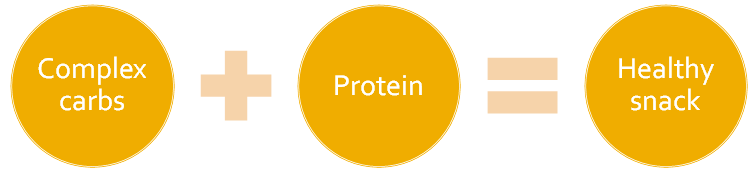
1. Complex carbohydrates
Complex carbs are fruits, vegetables and whole grains.
Common examples include: apples, bananas, carrots, whole grain crackers, whole grain bread, potatoes, brown rice, raisins, granola, whole grain cold cereal or oatmeal and legumes/beans (chickpeas, black beans, peas, etc.)

 |
2. Protein
Protein sources are dairy foods, meat and poultry, and nuts and seeds.
Common examples include: yogurt (Greek yogurt has more protein!), milk, cheese, lunch meat, chicken, hard boiled eggs, almonds or other nuts.
 |
| How much protein do you need? You're probably getting enough, but make sure you're getting some as part of your snacks! |
The Academy of Nutrition and Dietetics recommends making small swaps to your normal grocery cart by looking at the foods you "always" eat each week and trying to make a swap for a more nutritious option. For example, you can swap out those fruit snacks for a piece of fruit or swap that chocolate chip fiber bar for some nuts or whole grain cereal.

Again, your snack bar (or other favorite portable snack) may be satisfying and tasty, but you should set a goal to get more variety in your diet.
Remember, eating snacks and meals with more variety, from more than one food group, is going to provide you with the most nutritional "bang for your buck" - you're going to be getting more nutrients and feel more satisfied with, for example, and apple paired with some nuts vs. if you just ate the apple by itself.
The protein and healthy fats in the nuts help hold you over for longer and the carbohydrates in the apple give your body a quick source of energy.
10 portable snack ideas to throw in your backpack/bag/purse:
1. Almonds/mixed nuts (~1/4 cup) with an apple
2. String cheese and grapes
3. Greek yogurt with berries and 1/4 cup granola
4. Cheese and whole grain crackers
5. A cup of milk and whole grain cereal
6. Peanut butter* and celery with raisins
7. Nut butter and jelly sandwich on whole grain bread or crackers
8. 2 hard boiled eggs and an apple
9. 1/3 cup oatmeal cooked with milk and 1/2 Tbsp peanut butter
10. Beef jerky and carrots
*You can portion peanut butter into small containers if you don't want to bring the whole peanut butter jar to work/school.
Ask the Dietitian: What snacking questions do you have? What are your favorite snacks?
I love plain Greek yogurt with berries and flax seeds. If I don't want to bring a lunch bag or don't have access to a refrigerator to keep it cool, I opt for a piece of fruit and nuts or a tablespoon or 2 of peanut butter.

Source: National Dairy Council
Again, your snack bar (or other favorite portable snack) may be satisfying and tasty, but you should set a goal to get more variety in your diet.
Remember, eating snacks and meals with more variety, from more than one food group, is going to provide you with the most nutritional "bang for your buck" - you're going to be getting more nutrients and feel more satisfied with, for example, and apple paired with some nuts vs. if you just ate the apple by itself.
The protein and healthy fats in the nuts help hold you over for longer and the carbohydrates in the apple give your body a quick source of energy.
10 portable snack ideas to throw in your backpack/bag/purse:
1. Almonds/mixed nuts (~1/4 cup) with an apple
2. String cheese and grapes
3. Greek yogurt with berries and 1/4 cup granola
4. Cheese and whole grain crackers
5. A cup of milk and whole grain cereal
6. Peanut butter* and celery with raisins
7. Nut butter and jelly sandwich on whole grain bread or crackers
8. 2 hard boiled eggs and an apple
9. 1/3 cup oatmeal cooked with milk and 1/2 Tbsp peanut butter
10. Beef jerky and carrots
*You can portion peanut butter into small containers if you don't want to bring the whole peanut butter jar to work/school.
Ask the Dietitian: What snacking questions do you have? What are your favorite snacks?
I love plain Greek yogurt with berries and flax seeds. If I don't want to bring a lunch bag or don't have access to a refrigerator to keep it cool, I opt for a piece of fruit and nuts or a tablespoon or 2 of peanut butter.
Thursday, September 25, 2014
Nutrition for Recovery
Athletes invest time, effort and money in their sport. They buy cloths, shoes and gear that is necessary for them to excel. But, how much do they invest in their recovery plan?! Yes, recovery is also stretching, foam rolling and ice baths but what about nutrition for recovery?
The main purpose of nutrition for recovery is replenishing glycogen stores, repairing and rebuilding muscle as well as re-hydrating in order to get to the next practice like new (the 3 Rs).
Fueling for recovery does change based on the intensity and duration of your workout as well as when your next workout will occur. For example: Someone that has football practice in the morning for 1.5 hours and then a 1.5 hour lifting session in the afternoon will need to put a little more effort in fueling for recovery versus someone that ran for 60 minutes and will play tennis in 2 days. Athletes that rest 24 hours or more between sessions, do not have to put emphasis on nutrient timing when it comes to glycogen, withstanding they consume enough carbohydrates throughout the day.

 Other recovery options can be:
The main purpose of nutrition for recovery is replenishing glycogen stores, repairing and rebuilding muscle as well as re-hydrating in order to get to the next practice like new (the 3 Rs).
Fueling for recovery does change based on the intensity and duration of your workout as well as when your next workout will occur. For example: Someone that has football practice in the morning for 1.5 hours and then a 1.5 hour lifting session in the afternoon will need to put a little more effort in fueling for recovery versus someone that ran for 60 minutes and will play tennis in 2 days. Athletes that rest 24 hours or more between sessions, do not have to put emphasis on nutrient timing when it comes to glycogen, withstanding they consume enough carbohydrates throughout the day.
- Refuel (=replenish) - The main source of fuel utilized during exercise is carbohydrate. Carbohydrates are stored in the form of glycogen in the muscle and liver and these stores are drained the longer the activity is or the higher the intensity. Therefore, we need to replenish those glycogen stores, especially if there are multiple practices or tournaments in the same day. Refueling should start within 30-45 minutes after exercise. It is recommended to consume 1-1.5 gr/kg of carbohydrate every 2 hours up to 4-6 hours post activity (1 kg = 2.2 lbs. Example: 154 lbs=70 kg - Will need to consume 70-105 grams carbohydrates every 2 hours for up to 4-6 hours post exercise or until eating a meal).
- Rebuild - Exercise causes damage to the working muscle. Protein is the main nutrient that helps repair the damage and rebuild the muscle (muscle protein synthesis). Protein should be consumed within 2 hours of activity to promote a greater muscle growth. Combining protein with carbohydrate post workout has shown to enhance recovery. Recommendations for protein are 6-20 grams within 2 hours of activity.
- Rehydrate - During exercise we can lose quite a lot of fluids in the form of sweat. Sweat is not just contrived of water but also multiple electrolytes, mainly sodium, potassium and chloride. Therefore, to recover optimally we need to rehydrate with fluids and electrolytes. The best way to rehydrate properly is weighing yourself before and after practice. For each pound lost, drinking 16-24 oz is recommended. Hydrating throughout the day well, makes rehydrating for recovery much easier. Eating salty snacks and drinking a sports beverage could be a good way to help replenish some of the electrolytes lost.
Simple, right?! However, some people may have a hard time eating something post exercise. In that case, drinking could be an option. In fact, one of the best recovery drinks out there is chocolate milk. It has a combination of whey and casein (fast absorbed and slow absorbed high quality protein respectively), good amount of carbohydrates and its a liquid containing electrolytes. Win win!
Research also suggests the best ratio of carbohydrate to protein for recovery should be 2:1-4:1, chocolate milk is 3:1.
Other recovery options can be: - Yogurt with strawberries
- Milk and a banana
- Protein bar, water and a fruit
- Fruit smoothie
- Turkey and cheese sandwich with a sports beverage
- Cereal with milk and blueberries
It is also important to mention that part of a good recovery plan includes sleep. For more info on sleep refer to previous Sleep blog.
Investing in recovery is as important as the time you invest in training so remember to refuel, rebuild and rehydrate to achieve optimal recovery
Friday, August 8, 2014
Protein for Performance
Athletes literally brutalize themselves during workouts and training sessions. This makes nutrition extremely important for optimal performance, recovery and muscle rebuilding. Both hydration and carbohydrate are important for exercise adaptations and recovery, but it is also important to recognize protein.

Protein recommendations for athletes are in the range of 1.2 - 1.7 grams (g) of protein per kilogram (kg) of body weight a day (1 kg = 2.2 lbs) or 0.54 - 0.77 g/lb a day. Recommendations for endurance athletes would be on the low end at 1.2 - 1.4 g/kg (0.54 - 0.64 g/lb) of bodyweight and 1.5 – 1.7 g/kg (0.68 - 0.77 g/lb) for strength and power athletes. For example, an endurance athlete weighing 160 lbs (72.7 kg) would need approximately 87 - 102 grams of protein per day, whereas a 200 lbs (90.9 kg) bodybuilder may require 136 - 170 grams of protein per day. These recommendations may change as some current and emerging research suggests protein requirements may actually decrease in well-trained individuals due to a greater efficiency of dietary nitrogen utilization.
While there are several types of protein, whey protein may be the best choice after a workout. According to Dr. Stuart Phillips, whey protein is more effective than both soy and casein in promoting anabolism (muscle growth) in the fed-state or following exercise. This is due to the high leucine content – a branched chain amino acid – which is a trigger for activating muscle protein synthesis. But when it comes to post workout protein needs, more is not always better. In fact, several studies suggest 20 grams of whey protein (8.6 grams of essential amino acids) is sufficient for most athletes to maximally stimulate muscle protein synthesis. Older athletes may require as much as 40 grams of protein post exercise (16.8 grams of essential amino acids) to maximally stimulate muscle protein synthesis.
Protein consumption before or after exercise is important, but consuming high quality protein spaced evenly throughout the day may be just as essential for optimizing muscle protein synthesis. Throughout the day our bodies go through periods of muscle protein breakdown and muscle protein synthesis. Only when protein synthesis exceeds breakdown, does the growth of muscle mass occur. Therefore, it is important that athletes consume 4 to 5 equally spaced protein containing meals throughout the day versus the typical breakfast, lunch and supper regimen. It is recommended that each meal contains 0.25 - 0.30 g/kg protein. Using our previous example, our 160 lb endurance athlete should aim for 18 – 22 grams of protein per meal and our 200 lb bodybuilder should aim for 23 -27 grams of protein per meal. A protein containing small meal, such as Greek yogurt, prior to bed is also recommended to improve post exercise overnight recovery.
It is highly recommended to choose lean proteins such as: chicken, turkey, fish, lean parts of beef and pork, Greek yogurt and legumes (beans, lentils and chickpeas). In addition, chocolate milk is a great source of whey and could be used as a recovery drink post exercise (20 oz will provide 20 grams protein).
There is no one size fits all approach when it comes to individualized sports nutrition regimens. So always make sure to consult with a sports dietitian to ensure your nutrient needs are met for optimal performance, recovery, and muscle repair.
Guest blog by: Gavin Van De Walle; SDSU dietetic student and personal trainer
Friday, July 11, 2014
Nutrition for the Injured Athlete
We talk all the time about nutrition for performance and nutrition for recovery but there is not much talk about nutrition for injury. Is there even a specific regimen for the injured athlete?!
Unfortunately, there is not much research out there on the injured athlete so we don't have a specific regimen, however, we do have some knowledge and recommendations to help heal faster and get back in the game sooner.
Injury has 3 healing phases:


Unfortunately, there is not much research out there on the injured athlete so we don't have a specific regimen, however, we do have some knowledge and recommendations to help heal faster and get back in the game sooner.
Injury has 3 healing phases:
- Inflammation - occurs immediately up to 2-5 days post injury
- Proliferation - occurs 5 days - 3 weeks post. During this phase there is rebuilding and repairing
- Maturation - occurs 3 weeks - 2 years (depending on severity of injury). During this phase there is remodeling to a stronger structure
If the injury is serious we may not be able to immobilize which in turn will cause less muscle building, muscle loss, decrease in strength and of course decrease in performance.
Nutritionally, we divide recommendations to 2 phases:
- Injury and immobilization - during this phase most of the muscle loss occurs
- Rehabilitation - during this phase exercise is re-introduced in the form of therapy and advanced to full practice when able
Nutrition recommendations during Injury and immobilization (= inflammation and proliferation phase of healing):
- Energy (kcal) - demands of energy are slightly higher in order to assist with the healing processes. If injury is severe, energy expenditure can go up by 20%. If on crutches, energy expenditure can be 2-3 times higher than walking. Sometimes, a small weight gain is beneficial because with out enough calories we can prevent muscle protein synthesis (building muscle)
- Protein - During the immobilization phase we lose muscle which then causes us to lose strength. Protein helps us build and repair, therefore, are needs for protein are higher. Although we do not have an exact number of grams/lb we need per day, we assume its more than the DRI (dietary reference intake) which is 0.8 grams/kg (0.35 grams/lb). Some research suggests we need close to 1-1.2 grams/kg/day (0.45-0.55 grams/lb/day). Since the majority of us eat more protein than we need this should not be an issue
- Carbohydrates - When we exercise, carbohydrates are our main source of energy. However, when injured, we don't need as much, therefore, we may decrease carbohydrates slightly to prevent excessive weight gain. Sports beverages, gels, sodas and concentrated sweets are highly discouraged during this time
- Fats - very essential for healing. What type of fats is most important. Omega 3s (found in fatty fish as well as certain seeds/nuts) have been found to possibly help increase muscle protein synthesis (building muscle) as well as help with recovery and decreasing inflammation
- Vitamins and minerals:
* Vitamin C - Helps with wound healing, tissue repair and increased immune function. Foods rich in vitamin C include: citrus fruit, strawberries, red bell peppers, watermelon, etc.
* Vitamin A - Helps with cell growth and development as well as immune function. Foods high in vitamin A include: sweet potatoes, tomatoes, carrots, papaya (orange/red fruits and vegetables)
* Zinc - Helps with wound healing, protein synthesis and immune function. Foods rich with zinc include: beef, almonds, seeds (sunflower, flax, pumpkin, etc.) and seafood
* Vitamin D - Important for bone health and immune function. The sun vitamin - get 5-30 minutes of sun between 10 AM - 3 PM (time is based on skin color, the darker the skin the more time you need) or it can be found in dairy products, fatty fish or fortified foods
- Fluids - fluids are needed in order to deliver the different nutrients to the different organs and tissues. Moreover, its needed to support joints and soft tissues. Roughly, you should be drinking half your weight in ounces, preferably water.
Nutrition during rehabilitation phase
We treat this phase as we were to treat someone who does strength and conditioning. We put emphasis on enough energy and protein as well as healthy fats and plenty of vegetables and fruits. More on strength and conditioning nutrition in a future blog.
There are also foods/beverages that can prevent us from healing optimally, which we should avoid:
- Fried fatty foods (example: pizza, fried chicken, french fries, etc.)
- Added sugars and concentrated sweets (soda, candy, ice-cream, etc.)
- Being malnourished (more common in elderly but applies to people that restrict eating a lot)
- Less than optimal sleep (athletes should sleep 8-10 hours/day)
- Alcohol - it inhibits muscle protein synthesis and increases muscle loss
So, if you or any of your friends get injured, remember to also focus on nutrition to help speed your healing and recovery! Food always comes first and if need be, consult a sports RD or a sports MD for supplement recommendations.
Thursday, July 3, 2014
It's Eat Your Bean Day
Today, July 3rd, is national eat bean day, so why not celebrate it by adding some beans to your diet.
Beans (a legume) are a great source of protein, fiber, minerals and some B vitamins. They are low in fat and cholesterol. Here is the nutrition information for 0.5 cup cooked beans made from dried beans (taken from "Dietitians Online"):

Although beans do not make a complete protein, when you add them to a grain (example: rice and beans, couscous and lentils, barley and chick peas, etc.) they become a full protein. These combinations can help vegetarians and vegans, that don't eat meat, eggs and/or dairy, to meet their protein needs.
Beans have been shown to help with lowering cholesterol, triglycerides and blood pressure. Moreover, they can reduce risk for heart disease, some cancers, diabetes and bone disease (osteoporosis). Since beans are packed with fiber, they help you feel fuller longer as well as help your bowels move and prevent constipation.
There are multiple vitamins and minerals in beans including: potassium, magnesium, iron, zinc, thiamine, folate, B6, manganese, copper and more. Beans also contain anti-oxidants that help fight inflammation. On top of all that, beans are also quite cheap.
With all these great benefits, no wonder some people describe beans as a "super food".So next time you go to the grocery store pick yourself a bag of beans.
Not sure what to make?! check this great recipe for soft tacos with southwest vegetables from Mayo Clinic as well as these great healthy salad recipes from Cooking Light.
Enjoy and Happy 4th!

Beans (a legume) are a great source of protein, fiber, minerals and some B vitamins. They are low in fat and cholesterol. Here is the nutrition information for 0.5 cup cooked beans made from dried beans (taken from "Dietitians Online"):
Although beans do not make a complete protein, when you add them to a grain (example: rice and beans, couscous and lentils, barley and chick peas, etc.) they become a full protein. These combinations can help vegetarians and vegans, that don't eat meat, eggs and/or dairy, to meet their protein needs.
Beans have been shown to help with lowering cholesterol, triglycerides and blood pressure. Moreover, they can reduce risk for heart disease, some cancers, diabetes and bone disease (osteoporosis). Since beans are packed with fiber, they help you feel fuller longer as well as help your bowels move and prevent constipation.
There are multiple vitamins and minerals in beans including: potassium, magnesium, iron, zinc, thiamine, folate, B6, manganese, copper and more. Beans also contain anti-oxidants that help fight inflammation. On top of all that, beans are also quite cheap.
With all these great benefits, no wonder some people describe beans as a "super food".So next time you go to the grocery store pick yourself a bag of beans.
Not sure what to make?! check this great recipe for soft tacos with southwest vegetables from Mayo Clinic as well as these great healthy salad recipes from Cooking Light.
Enjoy and Happy 4th!

Friday, June 13, 2014
Grilling Season is on Its Way
This up coming Sunday, June 15th, is fathers day. What better way to celebrate fathers day with a good old BBQ meal (lunch or dinner).
Grilling is a great way to eat healthier as it eliminates a lot of the fat found in other cooking methods such as frying and pan frying. Moreover, it gives food this great smokey flavor that makes anything taste better.
To help assist build a complete & healthy grilled meal My Plate shall be our guide.

For healthy protein we can use: fish (salmon, walleye), chicken breast, loin or sirloin of beef/pork
For healthy grains we can choose a starchy vegetable: grill corn on the cob, grilled sweet potato or just make some brown rice.
For healthy vegetables we can grill up some asparagus, zucchini, summer squash and onions or create vegetable skewers. Cheese can also be added in skewers (ex: halumi, mozzarella)
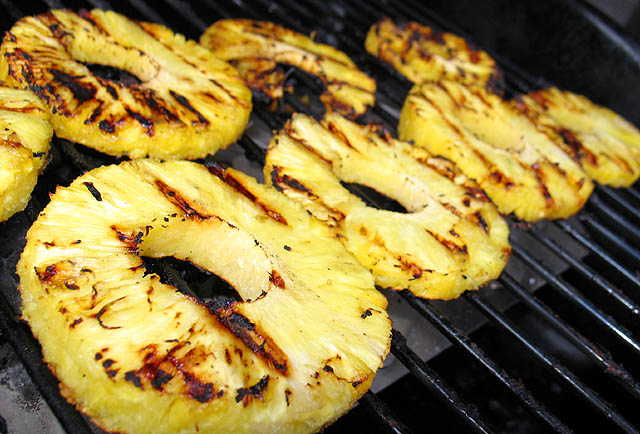
For healthy fruits we can have a fruit salad or even grill some pineapple with cinnamon.
Before you start grilling, make sure you clean the grill well. You can do so buy taking half an onion and running it over your hot grill before putting anything on it. Make sure you do the same when you are done as well.
Here are some recipes:
This recipe of Grilled Trout is from Cooking Light website
Ingredients
1 Tbps of fine sea salt
2 tsp of sugar
4 (7 oz) dressed rainbow trout
cooking spray
1/4 tsp black pepper
2 (1oz) bunches dill sprigs
2 limes thinly sliced

Grilling is a great way to eat healthier as it eliminates a lot of the fat found in other cooking methods such as frying and pan frying. Moreover, it gives food this great smokey flavor that makes anything taste better.
To help assist build a complete & healthy grilled meal My Plate shall be our guide.
For healthy protein we can use: fish (salmon, walleye), chicken breast, loin or sirloin of beef/pork
For healthy grains we can choose a starchy vegetable: grill corn on the cob, grilled sweet potato or just make some brown rice.
For healthy vegetables we can grill up some asparagus, zucchini, summer squash and onions or create vegetable skewers. Cheese can also be added in skewers (ex: halumi, mozzarella)
For healthy fruits we can have a fruit salad or even grill some pineapple with cinnamon.
Before you start grilling, make sure you clean the grill well. You can do so buy taking half an onion and running it over your hot grill before putting anything on it. Make sure you do the same when you are done as well.
Here are some recipes:
This recipe of Grilled Trout is from Cooking Light website
Ingredients
1 Tbps of fine sea salt
2 tsp of sugar
4 (7 oz) dressed rainbow trout
cooking spray
1/4 tsp black pepper
2 (1oz) bunches dill sprigs
2 limes thinly sliced

- Preparation
- 1. Combine 2 cups water, sea salt, and sugar in a shallow dish; add fish. Let stand 20 minutes. Drain.
- 2. Prepare charcoal fire in a chimney starter; let coals burn until flames die down. Pour hot coals out of starter; pile on one side of grill. Coat grill grate with cooking spray; put grate in place over coals.
- 3. Sprinkle 1/4 teaspoon salt and pepper over fish flesh. Divide dill and lime slices evenly among fish cavities. Coat outside of fish with cooking spray. Place fish over direct heat; grill 4 minutes. Turn over; move to indirect heat. Grill 12 minutes or until done
- This recipe is for grilled vegetables:
- Ingredients
1 zucchini cut into round circles
1 summer squash cut into round circles1 medium red onion cut into thick pieces1 cup of cherry tomatoes1 cup small mushrooms2 Tbsp olive oil1 Tbsp garlic powder1 tsp sea saltFresh rosemaryPepperPreparation1. Mix all vegetables together with oil, salt, pepper, garlic powder and rosemary. Let sit for 15-20 minutes2. Take as much skewers as needed and start putting vegetables on each skewer in a variety.3. Place skewers on direct heat. Grill for 5-10 minutes. Turn over andgrill 5-10 minutes or until done - For dessert you may want to use this great pineapple recipe (clean the grill before you put the pineapple in order to prevent meaty taste and contamination):Ingredients1 medium size pineapple cut into circles or chunks1 Tbsp cinnamonPreparation1. Sprinkle cinnamon all over pineapple2. Place pineapple with cinnamon directly on the grill.Grill for 5-10 minutes or until done
- There you have it! Grilling like a pro with My Plate.
- Happy Fathers Day!

Wednesday, August 7, 2013
Eating for Sport - Cross Country
Long distance running is demanding on the body; not only with energy requirements, but with the toll it takes on muscles. For that reason, proper nutrition cannot be over-looked. Miles add up very quickly throughout the course of the season so having a nutrition plan to help you keep up with your nutrient needs is absolutely necessary.
Are you meeting your energy demands? A 10 mile run could burn around 1,000 calories! A diet for runners should be comprised of mostly carbohydrate. By now, I am sure most of you have heard coaches or other people tell you to eat carbohydrates. Carbohydrates, when metabolized in the body, are converted into glucose. It is glucose that it is stored in muscles as glycogen. Your body is only able to store up to certain amount of glycogen and then it must be replenished by food after it is depleted. It is not like fat where your body has a high storage capacity.
Become familiar with foods that are high in carbohydrate. You probably already have some favorite pre-event snacks, but take a minute to look at them closely to see how much carbohydrate they actually offer you. Your carbohydrate intake should reflect how much you are training. If you doing extra training that day, eat more carbs. Your daily carbohydrate needs should be in the range of 3-4.5 grams per pound of body weight.
Protein and fat are still important in an athlete’s diet. Protein is needed to help build and repair muscle tissue. Eat approximately 0.55-0.64 grams per pound of body weight of protein per day.
Fat is needed for the absorption of some vitamins, insulation, and the production of hormones in the body. Fat should make up about 20-35% of your total calories for the day. Focus on unsaturated fats due to their added health benefits.
Being too restrictive with calorie intake will negatively affect your performance because it will not allow your body to properly fuel and refuel for your events. For women, eating too few calories can cause disruptions in her menstrual cycle. Loss of menstruation is not a normal part of training and should be discussed with a physician. The low levels of estrogen related to missing periods can impair bone mineral density, which can increase the risk for developing other health concerns such as osteoporosis.
A common nutrition concern for long distance runners, especially females, is iron. Many runners are at an increased risk for developing an iron deficiency, especially if they do not eat a lot of meat. When people suffer from an iron deficiency, they feel fatigued. But before running to the store and buying iron supplements, please seek advice from your personal or team physician. Iron supplements, like other supplements, have the potential of causing adverse effects if they are taken when they are not necessary.
Ready to head out for your long run? Choose a pre-exercise snack that, of course, is high in carbohydrate but also lower in protein, fat, and fiber. Eating foods that are high in these will likely cause some stomach upset while on your run because they take your body longer to digest. The longer time you have before you run, the larger meal or snack you can have without worry about it bothering your stomach. Don’t forget about eating after you get back! Eating a snack immediately after your run will help you replenish your energy stores. Choose a snack that is high in carbohydrate, but also offers some protein. Protein will help repair your muscles and allow you to recover more effectively before your next run. You are not done with your training until you eat your post-run snack!
As with any other sport, making sure you have adequate hydration is key to optimal performance. It only takes a 2% loss of body weight caused by dehydration to significantly impact your performance.
 |
| Photo Credit: Women's Health Magazine |
Become familiar with foods that are high in carbohydrate. You probably already have some favorite pre-event snacks, but take a minute to look at them closely to see how much carbohydrate they actually offer you. Your carbohydrate intake should reflect how much you are training. If you doing extra training that day, eat more carbs. Your daily carbohydrate needs should be in the range of 3-4.5 grams per pound of body weight.
Protein and fat are still important in an athlete’s diet. Protein is needed to help build and repair muscle tissue. Eat approximately 0.55-0.64 grams per pound of body weight of protein per day.
Fat is needed for the absorption of some vitamins, insulation, and the production of hormones in the body. Fat should make up about 20-35% of your total calories for the day. Focus on unsaturated fats due to their added health benefits.
Being too restrictive with calorie intake will negatively affect your performance because it will not allow your body to properly fuel and refuel for your events. For women, eating too few calories can cause disruptions in her menstrual cycle. Loss of menstruation is not a normal part of training and should be discussed with a physician. The low levels of estrogen related to missing periods can impair bone mineral density, which can increase the risk for developing other health concerns such as osteoporosis.
A common nutrition concern for long distance runners, especially females, is iron. Many runners are at an increased risk for developing an iron deficiency, especially if they do not eat a lot of meat. When people suffer from an iron deficiency, they feel fatigued. But before running to the store and buying iron supplements, please seek advice from your personal or team physician. Iron supplements, like other supplements, have the potential of causing adverse effects if they are taken when they are not necessary.
Ready to head out for your long run? Choose a pre-exercise snack that, of course, is high in carbohydrate but also lower in protein, fat, and fiber. Eating foods that are high in these will likely cause some stomach upset while on your run because they take your body longer to digest. The longer time you have before you run, the larger meal or snack you can have without worry about it bothering your stomach. Don’t forget about eating after you get back! Eating a snack immediately after your run will help you replenish your energy stores. Choose a snack that is high in carbohydrate, but also offers some protein. Protein will help repair your muscles and allow you to recover more effectively before your next run. You are not done with your training until you eat your post-run snack!
As with any other sport, making sure you have adequate hydration is key to optimal performance. It only takes a 2% loss of body weight caused by dehydration to significantly impact your performance.
Monday, December 10, 2012
Protein Powders: A Brief Overview

Protein powders are widely sold and used in the United States however there are different kinds and they can have different affects on our exercise routines. The two most common types of protein that companies manufacture are whey or casein powders. The difference between the two can make all the difference in your workout, but keep in mind that these powders are only necessary if you are not getting enough protein from dietary sources.
Whey is an extremely fast digesting protein that is also complete and high quality. This protein is about 20-25% of the protein found in milk.
Casein is also a high quality complete protein but is about 75-80% of the protein found in milk. This protein digests more slowly than whey.
Overall, both are high quality protein powders but their effects are very different. Researching the different types along with the safety of them will be greatly helpful in determining which is best for you. Always keep in mind these supplements are completely unnecessary when getting a balanced diet and can be dangerous.
Drinking a beverage, such as chocolate milk, contains both!
Guest Blogger: Alyssa Gehle, USD Dietetic Intern
Thursday, October 11, 2012
Chocolate Milk and the Athlete
Chocolate milk has been making headlines for some time now about it being the "athlete's drink." But do you really know why?
Before we dive into that too much, let's review a little what happens when we exercise. In our bodies, protein is constantly being built and broken down. This is called protein turn-over. A side effect of an exercise bout is the breaking down of proteins. Exercise causes some tissue damage and requires a little repair. Not only do you need the protein, but your carbohydrate stores need to be replenished as well. This is why there is a recommendation to eat a carbohydrate/protein snack post-exercise. The term "recovery snack" makes more sense now, doesn't it?

So what makes chocolate milk so special? Cow's milk is considered to be a high-quality protein because it contains all of the essential amino acids. Essential amino acids are those that are body cannot produce and must be taken in through the diet. It also contains more carbohydrates (cho) per serving when compared to regular white milk.
In a study led by the University of Connecticut, they examined chocolate milk consumption with endurance athletes and how it affected protein balance, glycogen, and performance. Runners were asked to complete a 45 minutes exercise. After that, each runner was given either chocolate milk (cho+pro) or a sweetened beverage (cho only).
At the end of the study, they found that the runners who drank the chocolate milk had greater protein synthesis and less protein breakdown than those who drank the sweetened beverage. Both drinks were able to maintain glycogen (cho) storage.
This study, along with others, show that it takes BOTH protein and carbohydrates to properly recover from exercise. Chocolate milk is a convenient (and tasty!) way to get the nutrients your body is craving. Remember- a recovery beverage should be consumed within 30 minutes of exercise to see the full effects.
Reference:
Lunn, W. R., Pasiakos, S. M., Colletto, M. R., Karfonta, K. E., Carbone, J. W., Anderson, J. M., & Rodriguez, N. R. (2012). Chocolate milk and endurance exercise recovery: protein balance, glycogen, and performance. Medicine and Science in Sports and Exercise, 44(4), 682-691.
Before we dive into that too much, let's review a little what happens when we exercise. In our bodies, protein is constantly being built and broken down. This is called protein turn-over. A side effect of an exercise bout is the breaking down of proteins. Exercise causes some tissue damage and requires a little repair. Not only do you need the protein, but your carbohydrate stores need to be replenished as well. This is why there is a recommendation to eat a carbohydrate/protein snack post-exercise. The term "recovery snack" makes more sense now, doesn't it?

So what makes chocolate milk so special? Cow's milk is considered to be a high-quality protein because it contains all of the essential amino acids. Essential amino acids are those that are body cannot produce and must be taken in through the diet. It also contains more carbohydrates (cho) per serving when compared to regular white milk.
In a study led by the University of Connecticut, they examined chocolate milk consumption with endurance athletes and how it affected protein balance, glycogen, and performance. Runners were asked to complete a 45 minutes exercise. After that, each runner was given either chocolate milk (cho+pro) or a sweetened beverage (cho only).
At the end of the study, they found that the runners who drank the chocolate milk had greater protein synthesis and less protein breakdown than those who drank the sweetened beverage. Both drinks were able to maintain glycogen (cho) storage.
This study, along with others, show that it takes BOTH protein and carbohydrates to properly recover from exercise. Chocolate milk is a convenient (and tasty!) way to get the nutrients your body is craving. Remember- a recovery beverage should be consumed within 30 minutes of exercise to see the full effects.
Reference:
Lunn, W. R., Pasiakos, S. M., Colletto, M. R., Karfonta, K. E., Carbone, J. W., Anderson, J. M., & Rodriguez, N. R. (2012). Chocolate milk and endurance exercise recovery: protein balance, glycogen, and performance. Medicine and Science in Sports and Exercise, 44(4), 682-691.
Tuesday, September 4, 2012
What do I eat to build muscle?

A common nutrition question for athletes is “how do I build muscle?” The most important thing to remember about building muscle is that it requires the training stimulus from the weight room along with adequate calories. Enough overall calories, not just in the form of protein, are needed for your body to have the energy to increase your lean mass. As a strength athlete, protein needs are increased slightly, but it may not be as much as you would think. A goal range of protein to be eaten throughout the day is 0.73-0.77g per pound. Eating a post-workout snack immediately after leaving the gym will help you see the effects of your training because it will be providing your body the nutrients it needs at the most effective time. Choose a snack that is a combination of carbohydrate and protein. An ideal portion of protein for a post-workout snack is around 10-20 grams. Any more than 20 grams of protein is not necessary and will not build any more muscle. Excess protein beyond will be broken down for storage rather than building extra muscle. Although protein shakes are convenient, they are not a necessity. They can be a convenient option, but whole foods give the same results and are often higher in other valuable nutrients such as vitamins and minerals.
Subscribe to:
Posts (Atom)

